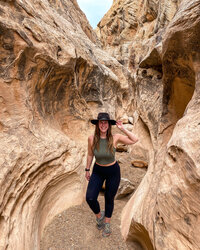
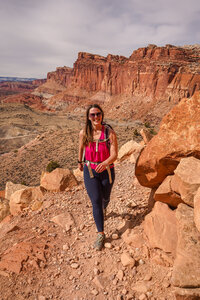

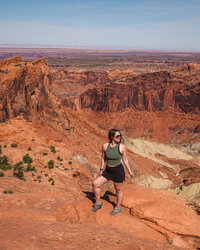

Capitol Reef is arguably the most underrated national park in Utah and one of my personal favorite areas to go hiking. The park offers a wide variety of trails that take you through some of the most stunning desert terrain in the Southwest, including towering canyons, arches, natural bridges, and unique geologic formations.
This guide details what I consider to be the best hikes in Capitol Reef National Park as someone who lives locally in the Southwest and has visited the park frequently over the past 7+ years. The hikes I’ve included vary from easy, family-friendly trails, to challenging, remote hikes for experienced adventurers.

Table of Contents: Best Hikes in Capitol Reef National Park
- Best Hikes in Capitol Reef:
- Recreating Responsibly in Capitol Reef
- FAQs About Hiking in Capitol Reef
1. Cassidy Arch via Cohab Canyon and the Frying Pan Trail
My favorite hike in Capitol Reef National Park is Cassidy Arch via Cohab Canyon and the Frying Pan Trail. While there are two different routes you can take to get to Cassidy Arch, including a shorter hike from Grand Gulch (more info below), I prefer this longer option because it takes you through varying terrain with gorgeous views.
The trail has everything you could want in a desert hike, including a scenic canyon, well-maintained trails with signage, and of course, an epic arch at the end. Unlike many arches in Utah, you can actually hike across Cassidy Arch. Don’t let photos deceive you, the arch is actually pretty wide, so walking across isn’t risky or scary (I say that as someone with a fear of heights!).

Trail Stats for Cassidy Arch via The Frying Pan Trail & Cohab Canyon
- Trailhead Location: Google maps
- Bathrooms?: There’s a pit toilet at the trailhead.
- Trailhead Parking Difficulty: Easy. There’s a large parking lot at the trailhead, along with other parking lots nearby.
- Distance: 8.3 miles (out-and-back)
- Elevation Gain: 2,400 ft.
- Difficulty: Difficult (7.5-8.5/10)
- Estimated Hike Time: 4 ½-5 ½ hours
- AllTrails Link
2. Hickman Bridge
The hike out to Hickman Bridge is short, relatively easy, and located right along the highway, which is why this is one of the most popular trails in Capitol Reef. The entire hike is just under 2 miles and packs in roughly 450 ft. of elevation gain. It’s suitable for hikers of all ages and experience levels, but be prepared for some rocky steps and terrain.
The star of the hike is, of course, Hickman Bridge. Clocking in at 133 ft. long, this natural bridge is one of the park’s most awe-striking geologic features. The majority of the hike follows an out-and-back trail, but there’s a small lollipop loop at the top near the bridge. As you approach Hickman Bridge you’ll see a sign suggesting to head right to hike the loop. From there, loop through the bridge and hike around back to the main trail, making a pit stop at an overlook area on your way.

Trail Stats for Hickman Bridge
- Trailhead Location: Google maps
- Bathrooms?: There’s a pit toilet at the trailhead.
- Trailhead Parking Difficulty: Easy-moderate. There’s a large parking lot at the trailhead, along with overflow parking along the highway, but parking can get crowded during peak seasons since it’s right along the highway.
- Distance: 1.9 miles roundtrip
- Elevation Gain: 450 ft.
- Difficulty: Easy (3-4/10)
- Estimated Hike Time: ~1 hour
- AllTrails Link
3. Grand Wash
If you’re looking for a family-friendly hike through a scenic canyon with towering sandstone walls, then Grand Wash is the perfect trail to check out. As the name suggests, the trail follows the bottom of a wash, so the terrain is sandy, but the hiking is pretty easy. There is a little bit of elevation gain as you make your way through the wash, but it’s so gradual that you barely notice you’re hiking slightly “uphill.”
You can either hike into Grand Wash from Highway 24 (what most people do), or you can start at the other end of the wash via a side road off of the Capitol Reef Scenic Drive. It’s also possible to hike up to Cassidy Arch from this side road.

Trail Stats for Grand Wash
- Trailhead Location: Google maps
- Bathrooms?: There is a pit toilet at the trailhead along Highway 24.
- Trailhead Parking Difficulty: Difficult. Parking is located right along the highway and spaces are somewhat limited. Make sure to park completely off of the road to avoid impeding traffic.
- Distance: ~5 miles out-and-back
- Elevation Gain: 340 ft.
- Difficulty: Easy (2-3/10)
- Estimated Hike Time: 1 ½-2 hours
- AllTrails Link
4. Chimney Rock Trail
The Chimney Rock Trail is located right along Highway 24 near the west entrance to Capitol Reef as you drive in from Torrey, Utah. It’s a relatively short trail, but has roughly 800 ft. of elevation gain, so it’s a great option if you’re short on time and want to get your blood pumping.
The lollipop loop trail climbs up Chimney Rock and provides breathtaking views of the park from two viewpoints, the Mummy Cliff Lookout and Chimney Rock Overlook. I recommend doing the loop portion of the hike clockwise for the best views.

Trail Stats for Chimney Rock Trail
- Trailhead Location: Google maps
- Bathrooms?: There is a pit toilet at the trailhead.
- Trailhead Parking Difficulty: Moderate-difficult. The trailhead serves multiple hikes, and since the parking lot is fairly small and right next to the highway, it often fills up quickly.
- Distance: 3.3 miles (lollipop loop)
- Elevation Gain: 800 ft.
- Difficulty: Moderate-difficult (6.5-7.5/10)
- Estimated Hike Time: 1 ½-2 hours
- AllTrails Link
5. Capitol Gorge to Water Tanks
Driving the Capitol Reef Scenic Drive is one of the best things to do when visiting Capitol Reef. There are a few hikes located along the scenic drive, but my favorite is the Capitol Gorge Trail, which is located at the end of the road.
The trail takes you up a wash before climbing up a side trail that provides stunning views of unique rock formations and the option to detour to the Water Tanks, which are a series of pot holes that are often filled with water. Along the way you’ll pass petroglyphs and a pioneer register from the 1800s.

Trail Stats for Capitol Gorge to Water Tanks Trail
- Trailhead Location: Google maps
- Bathrooms? There’s a pit toilet at the trailhead.
- Trailhead Parking Difficulty: Moderate-difficult. Parking spaces are somewhat limited. The last couple of miles to the trailhead are dirt, but should be accessible with any vehicle as long as it’s dry.
- Distance: 2.2 miles out-and-back
- Elevation Gain: 215 ft.
- Difficulty: Easy (3-4/10)
- Estimated Hike Time: 60-90 minutes
- AllTrails Link
6. Lower Spring Canyon Trail
The Lower Spring Canyon Trail is a challenging point-to-point hike that takes you from the Chimney Rock Trailhead to the Fremont River (or vice versa). Completing the hike requires fording the Fremont River, so the hike is best completed either in early spring before snowmelt raises the water level, or during the fall when flows are typically low.
Lower Spring Canyon is one of the most scenic canyon hikes in Capitol Reef, in my opinion. While you aren’t that far from the highway, as the crow flys, it feels as if you’ve been transported to a remote corner of the world. About 3 miles into the hike from the Chimney Rock trailhead you’ll reach an intersection with Upper Spring Canyon, which is a popular backpacking trip in Capitol Reef if you’re looking for something longer.


Trail Stats for Lower Spring Canyon Trail
- Trailhead Location: Google maps
- Bathrooms?: There is a pit toilet at the Chimney Rock Trailhead, but no bathrooms available at the other end of the hike.
- Trailhead Parking Difficulty: Moderate-difficult. The trailhead serves multiple hikes, and since the parking lot is fairly small and right next to the highway, it often fills up quickly.
- Distance: 10.5 miles point-to-point
- Elevation Gain: 1,100 ft.
- Difficulty: Moderate-difficult (7-8/10)
- Estimated Hike Time: 4-6 hours
- AllTrails Link
7. Goosenecks & Sunset Point
If you’re looking for a short and sweet hike in Capitol Reef National Park that provides great sunrise AND sunset views, then check out the Goosenecks & Sunset Point. The paved road up to the trailhead parking lot is located right off of Highway 24 and is suitable for all vehicles, which makes this a convenient, but popular trail.
The short trail takes you out to two different overlooks. The Goosenecks Overlook looks out over the Fremont River, while the Sunset Point Overlook provides views of the red rock canyons of Capitol Reef and the Henry Mountains in the distance to the east. The entire trail is roughly 2 ½ miles with limited elevation gain, which makes this a great hike for the whole family.

Trail Stats for Goosenecks & Sunset Point
- Trailhead Location: Google Maps
- Bathrooms? There are no bathrooms at the trailhead.
- Trailhead Parking Difficulty: Moderate-difficult. There are a limited number of parking spaces available at the trailhead.
- Distance: 2.5 miles out-and-back, including Goosenecks Overlook
- Elevation Gain: 275 ft.
- Difficulty: Easy (1.5-2.5/10)
- Estimated Hike Time: ~1 hour
- AllTrails Link
8. Upper Muley Twist
Upper Muley Twist is a challenging hike in the Waterpocket Fold district of Capitol Reef that packs in a variety of unique features along a roughly 10-mile lollipop loop trail. Along the way you’ll pass arches, seasonal waterfalls, colorful rock formations, and take in epic views of Strike Valley and the Henry Mountains.
This is one of my favorite hikes in Southern Utah, but since it’s so remote and requires route finding skills and some light scrambling, I recommend having a bit of desert hiking experience under your belt before attempting it.
If you decide to take this hike on it’s very important to be prepared by carrying a map, plenty of water, and all of the other 10 essentials (I have a full guide breaking down each of the 10 essentials if you don’t know what they are!). I also recommend having an emergency communication device, like a Garmin inReach mini, since you won’t have cell service.


Trail Stats for Upper Muley Twist
- Trailhead Location: Google maps
- Bathrooms? There are no bathrooms at the trailhead.
- Trailhead Parking Difficulty: Moderate-difficult. You need a high-clearance vehicle to drive up a wash to get to the official trailhead. There are places for low-clearance vehicles to park near Burr Trail Road, but this will add a few additional miles to your hike. Do not attempt to drive to the trailhead if rain is in the forecast due to flash flood risks!
- Distance: 10 miles (lollipop loop)
- Elevation Gain: 1,350 ft.
- Difficulty: Difficult (8-9/10)
- Estimated Hike Time: 5-6 hours
- AllTrails Link
9. Lower Muley Twist
Lower Muley Twist is another one of my favorite hikes located in the Waterpocket Fold district of Capitol Reef. It’s even more remote and challenging than Upper Muley Twist, but it makes for a fun adventure if you have solid desert route finding skills (definitely download and/or carry a map on this one!). My husband and I hiked Lower Muley Twist as a day hike, but it can also be done as a backpacking trip if you want to take your time.
There are two trailheads that you can start your hike from, either the Post Trailhead off of Notom-Bullfrog Road or at the top of the Burr Trail Switchbacks (driving the switchbacks is one of the best things to do in Capitol Reef!). I personally recommend parking at the Post Trailhead and hiking into the canyon via a route known as the cutoff trail, which takes you up and over the Waterpocket Fold.
Once you drop into Lower Muley Canyon the hiking is fairly easy since you’re just making your way through a canyon. From there you can either hike as far as you want and complete the hike as an out-and-back, or you can create a long 15+ mile loop and hike back out through Grand Gulch.


Trail Stats for Lower Muley Twist
- Trailhead Location: Google maps
- Bathrooms? There are no bathrooms at the trailhead.
- Trailhead Parking Difficulty: Moderate. There’s plenty of parking available at the Post Trailhead. It’s easier to drive to the trailhead from Lake Powell along Bullfrog Rd. from the south than it is to access it via Notom Road from the north.
- Distance: 9+ miles depending on how far you hike in the canyon
- Elevation Gain: ~1,000 ft.
- Difficulty: Difficult (8-9/10)
- Estimated Hike Time: 4-6 hours
- AllTrails Link
Trailhead Map: Best Hikes in Capitol Reef National Park
Recreating Responsibly in Capitol Reef National Park
Leave No Trace
It’s important to follow the 7 Leave No Trace principles when hiking and recreating outdoors to help minimize your impact on the environment. The 7 principles are:
- Plan ahead & prepare. Hiking in the desert comes with unique considerations, so make sure you fully research your hikes ahead of time and pack/dress appropriately. Always carry the 10 essentials!
- Travel & camp on durable surfaces. Stay on trails or other durable surfaces like slickrock and washes when hiking in Capitol Reef.
- Dispose of waste properly. Pack out all of your waste and trash, including food scraps and human waste, which doesn’t break down easily in the desert (carry a WAG bag to easily do this).
- Leave what you find. Leave natural resources where you find them. Never carve into, take, or stack rocks.
- Minimize campfire impacts. Check for fire bans and practice campfire safety if you’re camping during your trip to Capitol Reef. This means creating your campfire in an existing fire ring; making sure the fire is attended and doesn’t get out of control; and making sure the fire is out completely (stir the ashes until they are cool to the touch).
- Respect wildlife. Never feed wildlife. Make sure to maintain a safe distance from wildlife.
- Be considerate of others. Wear headphones instead of playing music over a bluetooth speaker. Remember uphill hikers have the right of way.

Respect Archaeological Sites
Capitol Reef National Park is the ancestral homeland of the Ute, Paiute, Navajo, and other Indigenous groups whose presence remains in the area today. You may encounter archaeological sites or petroglyphs while hiking in the park.
Cultural sites are protected by numerous federal laws, including the Archaeological Resources Protection Act and National Historic Preservation Act. Damaging, defacing, or destroying an archaeological site is a federal crime. Please treat the land and any archaeological sites or petroglyphs you encounter with respect when hiking in Capitol Reef.
Here are some best practices when visiting an archaeological site:
- Never sit, touch, lean, or stand on walls of archaeological sites.
- Don’t touch petroglyphs and pictographs (the oils from your fingers can break them down faster).
- Leave all artifacts where you find them.
- Don’t allow small children in archaeological sites.

Don’t Bust the Crust!
A lot of the desert in Southern Utah is covered in biological soil crust, otherwise known as cryptobiotic soil. Cryptobiotic soil plays a critical role in the desert ecosystem by helping to prevent erosion and is extremely delicate. It can take decades to recover from damage, so it’s important to stay on developed trails, or travel over durable surfaces like dry washes or slickrock, to avoid busting the crust!
Stay Safe When Hiking Through Canyons
Before you head out on any canyon hike, it’s incredibly important to be prepared and know the risks, including flash floods. Check out my complete guide on slot canyon safety for detailed safety tips.
All of the canyons in this Capitol Reef hiking guide are considered non-technical. This means that you do not need canyoneering gear, like ropes, a harness, and helmet, to navigate through them. However, scrambling may be required and because flash floods can change the conditions in a slot canyon, the difficulty may change over time.

FAQs: Hiking in Capitol Reef National Park
1. Is there a fee to enter Capitol Reef National Park?
Unlike most national parks, Capitol Reef doesn’t have a typical entrance booth where you have to pay an entrance fee. However, you still technically need to have a park pass to access trails and you could be asked by NPS staff to show your pass. A pass costs $20/vehicle or you can use an America the Beautiful pass, which you can purchase at the Visitor Center.
2. When is the best season to hike in Capitol Reef?
The best seasons to hike in Capitol Reef are the spring and fall when the weather is pleasant. However, spring and fall are also considered to be “peak” seasons in Southern Utah, so this is also when the park tends to be the busiest.
During the summer temperatures can easily soar up to 90-100°+, which makes hiking risky, especially since many of the trails are exposed to the sun. Dangerous monsoon storms are also common during the summer, which increases the risk of flash floods.
I personally think winter is also a great time to hike in Capitol Reef since you don’t have to worry about the heat, but you may encounter snow and ice on trails, particularly in canyons. Daylight is also limited during the winter, which cuts into your hiking time. Make sure to carry a headlamp in case you aren’t back to your car before dark!
3. Are there any dog-friendly hikes in Capitol Reef?
There are no dog-friendly trails in Capitol Reef National Park. If you’re visiting the park with your dog (or are just driving through on Highway 24), the best place to go is the Chestnut and Doc Inglesby picnic area located near the Visitor Center.
If you’re looking for dog-friendly hikes in the vicinity, I recommend heading to Hanksville or Escalante, which have tons of BLM (Bureau of Land Management) land in the area that is open to dogs.
Planning a road trip through Southern Utah and want more hiking recommendations? Check out my Southern Utah Road Trip + Hiking Guide! This digital guide comes with over 170 hikes, scenic viewpoints, places to stay, and things to do across Southern Utah, including all 5 of the national parks.
Pin It For Later: